Where does your organization stand on the content operations maturity spectrum?
Most cannot answer this question precisely. They have a general sense that things could be better, but lack a framework for assessing their current state or planning improvement.
This is important given that content operations maturity is a direct factor in whether your CMS investment would be value-delivering. In a 2024 survey of Fortune 1000 by AIIM, only 12% of organizations have level 4 or higher content operations maturity. Most (58%) of them are at Level 2, whereas 23% are at Level 1.
These figures match what we observe in our work with enterprise clients. Organizations often arrive with sophisticated CMS platforms but lack the operational structure to run them effectively. The implementation was successful. The operations were not planned for. We have seen marketing teams processing 400+ content requests annually through informal channels, multilingual programs running across six languages without standardized workflows, and governance existing only in policy documents that no one follows. The pattern is consistent: technology investment without operational investment.
The current guide is a list of our Enterprise Content Operations Maturity Model that we use to evaluate organizations and devise ways to improve them. This framework will give you a structure in the conversation, whether you are assessing the operations that you have, you are developing a business case to invest, or benchmarking against what other companies are doing.
Why Maturity Models Matter
Research consistently shows that most digital transformation initiatives fail to meet their objectives. BCG’s 2021 study of over 850 companies found that only 35% meet their value targets globally.
The failures are rarely technological. The platforms work. The operations do not.
Maturity models help organizations understand why this happens and what to do about it. They provide:
- A common language for discussing the current state and goals
- A framework for identifying specific gaps rather than general dissatisfaction
- A roadmap for sequenced improvement rather than random initiatives
- Benchmarks for measuring progress over time
The maturity model presented here is specific to enterprise content operations. It focuses on the operational capabilities required to run content ecosystems effectively after implementation, not on content strategy or content marketing, which are related but distinct disciplines.
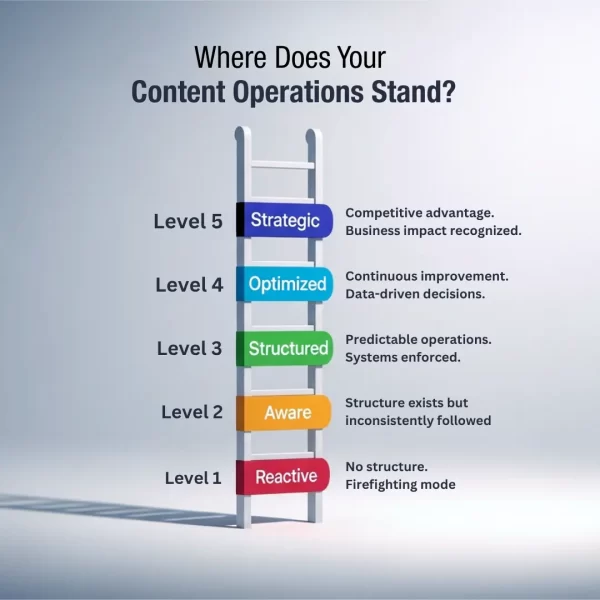
The Five Levels of Content Operations Maturity
Level 1: Reactive
At Level 1, content operations happen, but without structure or predictability.
Characteristics:
Content requests arrive through multiple channels: email, chat, phone calls, and hallway conversations. There is no central intake system.
Work is assigned based on who is available or who happens to receive the request. There is no formal prioritization.
Quality depends entirely on individual effort. Some content is excellent. Some have errors. There is no consistent standard.
Publishing happens when someone remembers to do it. There are no SLAs or turnaround expectations.
Governance exists on paper (if at all) but is not enforced. People can publish without review if they have access.
The team is in constant firefighting mode. Everything feels urgent. Nothing feels sustainable.
Symptoms you might recognize:
“I sent that request last week. Has anyone started on it?”
“Who approved this? It has errors.”
“We need this live today. Can someone just publish it?”
“I’m not sure what’s on the website anymore.”
Scale ceiling: Organizations at Level 1 can manage low content volumes with heroic individual effort. As volume increases, quality degrades, delays compound, and team burnout accelerates.
What Level 1 organizations need: Basic structure. A central intake system. Clear ownership. Minimal governance that is actually enforced.
Level 2: Aware
At Level 2, organizations recognize the need for structure and have implemented basic systems, but execution is inconsistent.
Characteristics:
There is a request intake system (email template, form, ticketing system). It is not used by everyone at all times, but there is a particular channel.
Simple prioritization occurs. Emergency requests are addressed. But standards are unofficial, and judgments are not objective.
There are quality standards that are irregularly enforced. Reviews happen sometimes. Mistakes continue to make it to production.
Turnaround expectations exist but are frequently missed. “Best effort” is the practical standard.
Workflow exists in the CMS but is often bypassed. People know they should follow the process, but find workarounds when deadlines press.
The team has moments of stability between periods of chaos.
Symptoms you might recognize:
“We have a process, but people don’t always follow it.”
“The backlog keeps growing even though we’re working constantly.”
“Quality is better than it was, but we still catch errors after publishing.”
“I know we have a workflow, but I’m not sure everyone uses it.”
Scale ceiling: Organizations at Level 2 can manage moderate content volumes when things are calm. Spikes (campaigns, product launches, seasonal pushes) overwhelm the system and force triage.
What Level 2 organizations need: Enforcement. Converting documented processes into actual practice. Measurement that reveals where breakdowns occur.
Level 3: Structured
At Level 3, content operations work most of the time predictably. Systems are in place and consistently used.
Characteristics:
All content requests flow through a central system. Exceptions are rare.
Clear prioritization criteria exist. Teams can explain why work is sequenced the way it is.
Quality standards are documented and consistently applied. Review gates catch most errors before publishing.
SLAs exist and are generally met. When they are missed, it is notable rather than routine.
Workflows are followed. The CMS enforces governance rather than relying on individual discipline.
The team operates most of the time sustainably. Peak periods are challenging but manageable.
Measurement exists. Request volume, completion time, and error rates are tracked.
Symptoms you might recognize:
“Our process works. We know what to expect.”
“Quality is consistent. Major errors are rare.”
“We meet our SLAs most weeks.”
“I can show you our metrics from last quarter.”
Scale ceiling: Organizations at Level 3 can handle significant content volume with predictable results. They struggle with rapid scale (acquisitions, new markets, major platform changes) because processes are designed for the current scope.
What Level 3 organizations need: Optimization. Identifying bottlenecks and removing them. Building capacity for growth. Moving from reactive measurement to predictive planning.
Not sure where your organization stands?
Download our free Content Operations Maturity Assessment Worksheet – a practical tool to score your organization across all five dimensions and identify your highest-priority improvement areas.
Level 4: Optimized
At Level 4, content operations are not just working but improving continuously.
Characteristics:
Processes are regularly reviewed and refined based on performance data.
Bottlenecks are identified and resolved proactively, not just when they cause problems.
Capacity planning happens. Teams anticipate workload changes rather than reacting to them.
Cross-functional coordination is smooth. Content operations connect effectively with marketing, IT, legal, and other stakeholders.
Technology is leveraged fully. CMS capabilities that were purchased are actually used.
The team has time for improvement work, not just production work.
Skills development is ongoing. Team members grow their capabilities systematically.
Symptoms you might recognize:
“We saw that bottleneck forming and addressed it before it became a problem.”
“Our turnaround time has improved 30% over the past year.”
“We use most of the features we’re paying for.”
“The team is learning new skills, not just executing repetitive tasks.”
Scale ceiling: Organizations at Level 4 can scale content operations effectively. They handle growth, new requirements, and change without losing quality or burning out teams.
What Level 4 organizations need: Strategic integration. Connecting content operations to broader business outcomes. Moving from operational excellence to competitive advantage.
Level 5: Strategic
At Level 5, content operations is recognized as a strategic capability that drives business value, not just an operational function that keeps the website running.
Characteristics:
Content operations metrics connect to business outcomes. Leadership understands the relationship between operational investment and results.
Content operations inform strategy, not just execute it. Operational insights shape content planning and platform decisions. For example, content operations data might reveal that localization for a new market takes 12 weeks with current capacity, informing the decision to delay a product launch or invest in additional resources before announcing. Or operational insights might show that 60% of content requests come from a single business unit, prompting a conversation about dedicated capacity allocation rather than shared services.
Innovation happens. New approaches are tested, measured, and adopted when effective.
The organization can respond rapidly to new requirements. New markets, new channels, and new content types are absorbed efficiently.
Content operations are a source of competitive advantage. The organization can do things competitors cannot.
Talent is attracted and retained. Working in content operations is a desirable career path.
Symptoms you might recognize:
“Our content operations capability lets us launch faster than competitors.”
“Leadership understands the ROI of our operations investment.”
“We’re piloting new approaches that could transform how we work.”
“People want to work here. We’re known for operational excellence.”
“We delayed the APAC launch by six weeks based on content operations capacity data. Leadership appreciated the early visibility.”
“Our content operations metrics are in the quarterly board deck alongside revenue and customer satisfaction.”
This level is rare. Most organizations aspire to Level 4 and consider Level 5 a long-term vision.
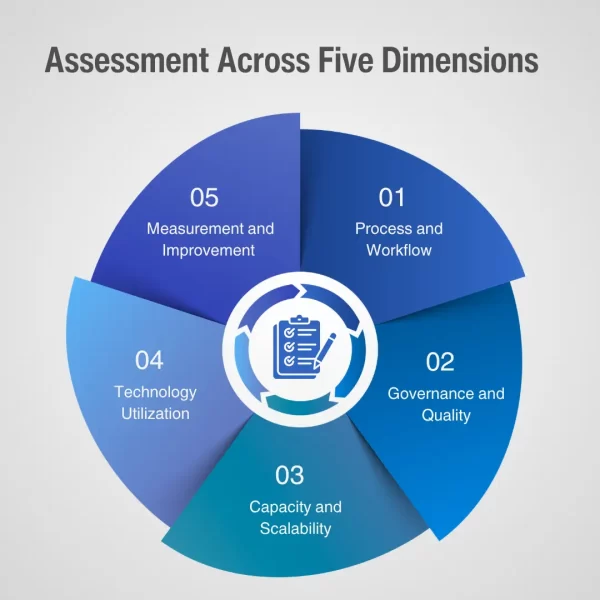
Assessment Across Five Dimensions
Maturity is not uniform. Organizations typically have different maturity levels across different operational dimensions. A complete assessment evaluates each dimension separately.
Dimension 1: Process and Workflow
How content moves from request to publication.
Level 1: No defined process. Work happens ad hoc.
Level 2: Process documented but inconsistently followed.
Level 3: Process enforced through systems. Consistent execution.
Level 4: Process optimized based on performance data. Continuous improvement.
Level 5: Process adapts dynamically to changing requirements.
Questions to assess:
- How do content requests arrive?
- Is there a single system of record for all requests?
- What percentage of requests follow the defined process?
- When was the process last updated based on performance data?
Dimension 2: Governance and Quality
How standards are maintained and errors prevented.
Level 1: No governance. Anyone can publish anything.
Level 2: Standards documented but not enforced.
Level 3: Governance enforced through workflow. Review gates prevent errors.
Level 4: Quality measured and improved. Error rates tracked and reduced.
Level 5: Quality is a competitive advantage. Near-zero defect rates.
Questions to assess:
- Who can publish content without review?
- What is your content error rate?
- When did a significant error last reach production?
- How do you identify and address recurring quality issues?
Dimension 3: Capacity and Scalability
How workload is managed, and growth accommodated.
Level 1: No capacity awareness. Work is accepted until the team is overwhelmed.
Level 2: Capacity constraints recognized but not systematically managed.
Level 3: Capacity planned. SLAs set based on realistic throughput.
Level 4: Capacity forecasted. Workload spikes are anticipated and prepared for.
Level 5: Capacity scales elastically. Growth absorbed without degradation.
Questions to assess:
- Do you know your team’s weekly capacity in request volume?
- How do you handle workload spikes?
- When did you last miss SLAs due to capacity constraints?
- How would you absorb a 50% increase in content volume?
Dimension 4: Technology Utilization
How effectively platforms and tools are used.
Level 1: Basic features only. Most platform capabilities are unused.
Level 2: Some advanced features are used inconsistently.
Level 3: Core features used systematically. Workflows, permissions, and governance are enforced.
Level 4: Advanced features leveraged. Personalization, automation, and optimization are active.
Level 5: Platform capabilities fully exploited. Technology enables differentiation.
Questions to assess:
- What percentage of purchased CMS features are actively used?
- Are workflows enforced through the platform or just documented?
- What automation exists in your content operations?
- When did you last implement a new platform capability?
Dimension 5: Measurement and Improvement
How performance is tracked and enhanced.
Level 1: No measurement. Success is anecdotal.
Level 2: Basic metrics tracked inconsistently.
Level 3: Core metrics tracked systematically. Reports available.
Level 4: Metrics drive decisions. Improvement initiatives based on data.
Level 5: Predictive analytics. Future performance anticipated and optimized.
Questions to assess:
- What metrics do you track for content operations?
- How often do you review performance data?
- When did metrics last drive a process change?
- Can you predict next month’s capacity requirements?
If you’re seeing bottlenecks but can’t quantify them, use this assessment to identify exactly where your operations are breaking down.
How to Use This Model
For Self-Assessment
Rate your organization on each dimension (1-5). Be honest. Aspirational ratings prevent useful diagnosis.
Calculate your overall maturity as the average across dimensions, but pay attention to the spread. An organization that is Level 4 in process but Level 1 in measurement has specific work to do.
Identify your limiting dimension. Overall maturity is often constrained by the lowest-rated dimension. Improving that dimension may unlock progress elsewhere.
For Planning Improvement
Focus on moving one level at a time. Jumping from Level 1 to Level 4 is not realistic. Sustainable improvement is sequential.
Prioritize based on business impact. Not all dimensions matter equally for your situation. If quality errors are causing customer complaints, focus on governance. If missed deadlines are losing campaigns, focus on capacity.
Set specific targets. “Improve content operations” is vague. “Move from Level 2 to Level 3 in the process dimension by Q3” is actionable.
For Building Business Cases
This model provides language for investment conversations. Instead of “we need more resources,” you can say “we are at Level 2 maturity and need to reach Level 3, which requires these specific capabilities.”
Connect maturity levels to business outcomes. Level 3 organizations have predictable quality and turnaround. Level 4 organizations can scale without degradation. What is that worth to your business?
For Client and Prospect Conversations
We use this model in discovery calls to understand where potential clients stand and what they need. “Where would you place yourself on this model?” opens a productive conversation.
The Path Forward
Most organizations we work with are at Level 2 or early Level 3. They have implemented some structure, but are not yet operating consistently or optimizing systematically.
Level 2 to Level 3: The Discipline Phase (6-9 months)
The gap is not about creating new processes. It is about enforcing existing ones.
- Convert documented processes into enforced workflows. If your CMS has workflow capability, use it.
- Establish a single intake channel and close the others. No exceptions.
- Implement three core metrics: request volume, turnaround time, and error rate. Review monthly.
- Create accountability. Someone owns content operations as their job, not a side responsibility.
Level 3 to Level 4: The Optimization Phase (9-12 months)
Once operations are predictable, the focus shifts from consistency to improvement.
- Move from reactive measurement to proactive analysis. Identify why, not just what.
- Build capacity planning into operations. Forecast demand. Identify constraints before they become bottlenecks.
- Create time for improvement work. Budget 10-20% of capacity for process improvement.
- Develop team skills beyond current requirements. Cross-train. Build depth.
Level 4 to Level 5: The Strategic Phase (12-24 months)
This transition is different. It is about strategic integration, not operational excellence.
- Connect content operations metrics to business outcomes.
- Build content operations into strategic planning as an input, not an afterthought.
- Position content operations as a capability, not a cost center.
Most organizations find sustainable success at Level 4. Level 5 is a choice for organizations where content operations are genuinely strategic to their competitive position.
The Investment Reality
Moving one maturity level typically takes 6-12 months of focused effort. Organizations attempting to skip levels usually regress. Sustainable improvement requires building capability and changing behavior, not just implementing new systems.
External partners can accelerate progress by providing expertise and capacity. But the change must be owned internally.
If you would like an outside perspective, schedule a 30-minute assessment call with our team. We will discuss your current state, identify quick wins, and outline what Level 3 or Level 4 could look like for your organization.

A content operations maturity model is a framework for assessing how effectively an organization manages its content ecosystem. It defines levels of capability (typically five) and criteria for each level, allowing organizations to identify their current state, set improvement targets, and measure progress over time.
Assess your organization in a variety of dimensions: process and workflow, governance and quality, capacity and scalability, technology use, and measurement and improvement. Evaluate each dimension truthfully depending upon actual practice (not as written) and then spot patterns and priorities of improvement.
Research shows only about one-third of digital transformations meet their objectives (BCG, 2021). Common causes include lack of clear ownership, underinvestment in change management, focus on technology rather than operations, and attempting to skip maturity levels rather than building capability sequentially.
Level 2 organizations have documented processes that are inconsistently followed. Level 3 organizations have enforced processes that are consistently executed. The key difference is not documentation but discipline and systematic enforcement through technology and management practice.
Moving one maturity level typically takes 6-12 months of focused effort. Organizations attempting to skip levels or move faster usually regress. Sustainable improvement requires building capability and changing behavior, not just implementing new systems.
Resources depend on current state and target. Moving from Level 1 to Level 2 may require basic systems and process documentation. Moving from Level 3 to Level 4 requires investment in measurement, analysis, and continuous improvement capability. External partners can accelerate progress by providing expertise and capacity.