

What is Enterprise Content Operations? Complete Guide for 2026
Enterprise content operations is the work that happens after your CMS goes live.
These involve publishing on a daily basis, translation coordination, governance, quality assurance, and continuous optimization of the site to ensure optimum performance.
This is not an implementation. Implementation builds the platform. Content operations runs it.
This is not campaign work. Campaigns are periodic. Content operations are continuous.
This daily effort establishes the level of value or underutilization of a CMS investment.
Most organizations invest heavily in their platforms and implementations. Far fewer invest adequately in operations. That gap explains why capable platforms frequently underperform.
Why Enterprise Content Operations Matters Now
Fortune Business Insights estimates the enterprise content management market to be valued at USD 42.93 billion in 2024 and is estimated to grow to USD 150.97 billion by 2032 with a 17.2 percent annual growth.
Companies are spending big on such solutions such as Sitecore, Adobe Experience Manager, Contentful, and WordPress Enterprise. It is a high-tech system. The features are extensive.
However, studies have always indicated that technology is not the bottleneck. The lack of skills, rather than technology, is the bottleneck, as observed by one industry analyst at the 2024 Information and Data Leadership Symposium of AIIM.
The platforms are capable. The gap is operational.
This trend is repeated in businesses. Capable platforms. Significant investments. Disappointing results. The absent factor is nearly always the same: operational dedication to the successful running of the platform.
The Hidden Cost of Poor Content Operations
Poor content operations have measurable consequences.
According to McKinsey research, employees spend 1.8 hours every day searching and gathering information. That is 9 hours per week, on average. Put another way, businesses hire five employees, but only four show up to work productively. The fifth is off searching for answers.
According to the research carried out by the IDC, businesses can lose up to 21.3% of their productivity as a result of document-related issues. This is in monetary terms equivalent to about USD 19,732 per information worker per annum.
These numbers reflect what happens when content is not managed well, when publishing workflows break down, when governance lapses, and when the operational foundation is missing.
Defining Enterprise Content Operations
Enterprise content operations refer to all that is needed to operate a content ecosystem on an enterprise level on a continuous basis.
The scope includes:
Daily Content Publishing: Creating, editing, reviewing, and publishing content across websites, applications, and digital channels. This is the principal work that maintains the website’s current relevance.
Content Governance: Enforcing standards, managing approvals, maintaining audit trails, and ensuring compliance with brand guidelines and regulatory requirements.
Multilingual Content Management: Coordinating translations, synchronizing content across languages, and maintaining consistency across markets.
Quality Assurance: Reviewing content before publication, catching errors, verifying links, checking formatting, and ensuring accuracy.
Platform Optimization: Maintaining the CMS itself, optimizing workflows, improving author experience, and keeping the platform performing well.
SEO and Performance: Optimizing content for search, maintaining technical SEO elements, monitoring performance, and making ongoing improvements.
Reporting and Analytics: Tracking content performance, measuring outcomes, and providing visibility into operations.
These functions happen continuously. Not as projects with end dates. Not as occasional initiatives. Every day, consistently, at the quality level enterprises require.
How Content Operations Differs From Related Disciplines
Content operations are easily confused with related but different operations. Understanding the differences helps to explain the importance of a particular operational focus.
Content Operations vs. Implementation
Implementation is a project work. It has a defined scope, timeline, and deliverables. Implementation partners set up platforms, build integrations, develop templates, and go live. Then the project is over, and the partner moves on.
Content operations is a continuous work. It has no end date. The scope evolves with business needs. Operations teams show up every day and run the platform indefinitely.
Implementation builds the car. Operations drive it.
Both are necessary. Neither replaces the other. The challenge is that most organizations invest heavily in implementation and underinvest in operations, creating the gap that causes post-implementation struggles.
Content Operations vs. Content Strategy
Content strategy is the process of defining what content you are going to create, for whom, and why. It addresses messaging, audience, positioning, and editorial direction.
Content operations implement that strategy. It takes care of the workflows, processes, and execution needed to execute the strategic plans to life on a consistent basis.
Strategy without operations creates plans that are never fully realized. Operations without a strategy produce activity without direction. Both are needed.
Content Operations vs. Content Marketing
Content marketing is more about creating content to attract and engage audiences, usually for the purpose of lead generation or brand awareness.
Content operations are much broader. Not only marketing content, but also includes product content, support content, compliance content, internal content, and any other content published by the organization.
Content marketing is a use case. Content operations is an operational discipline that supports multiple use cases.
Content Operations vs. Enterprise Content Management
Enterprise Content Management (ECM) traditionally refers to systems and strategies for managing internal business documents: Contracts, policies, records, and so on.
Enterprise content operations, as we use the term, is concerned with customer-facing digital content: websites, applications, and digital experiences.
The terminology can overlap, but the focus is different. ECM is used to manage internal documents. Content operations is the external digital presence.
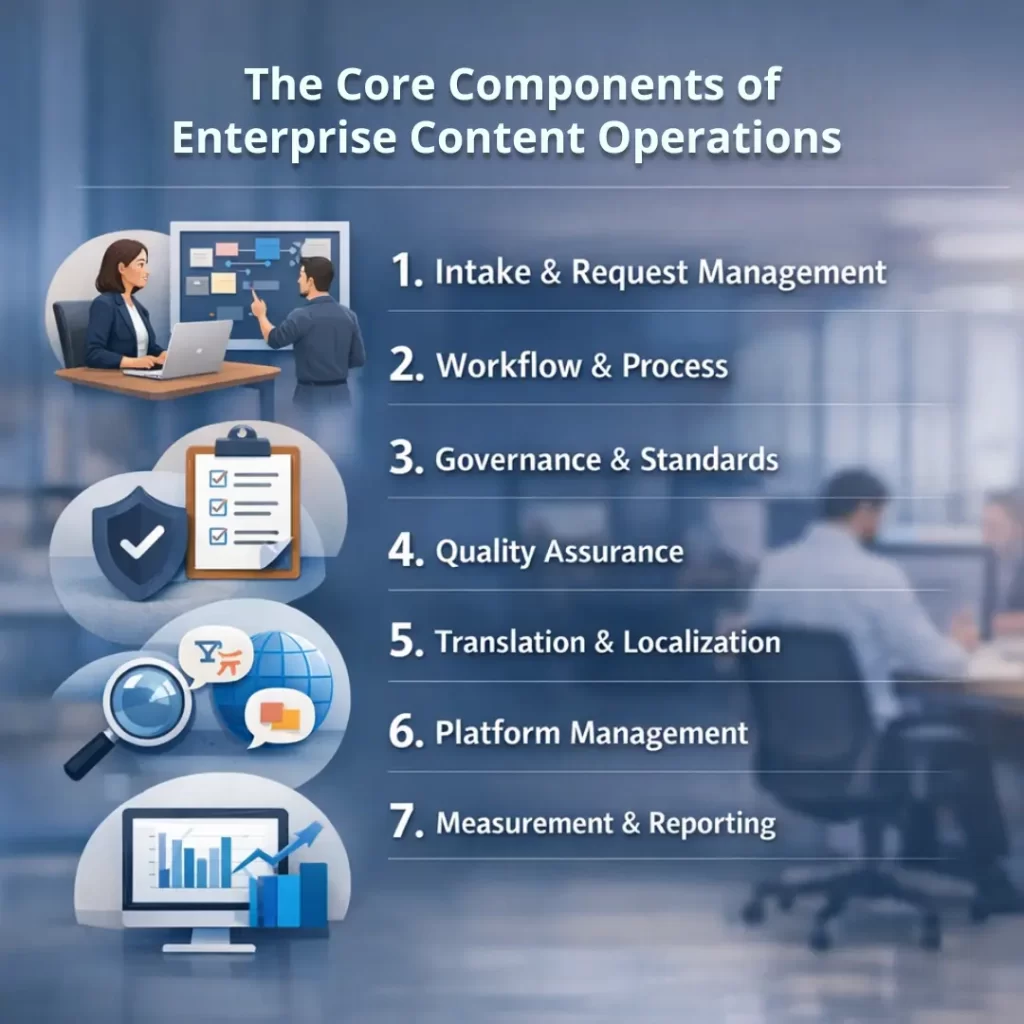
The Core Components of Enterprise Content Operations
Effective enterprise content operations require a number of interconnected pieces working together.
1. Intake and Request Management
Content requests come from multiple sources: marketing teams, product teams, regional offices, agencies, and executives. Without a defined intake, requests come in via email, chat, hallway, and urgent phone calls.
Structured intake means one door that people go through, and you capture the information up front; what do you need, when do you need it, what assets do you need, who needs to sign off?
This creates visibility, enables prioritization, and prevents requests from falling through cracks.
2. Workflow and Process
Content passes through predictable phases: request, creation, review, approval, publication, and sometimes translation and localization. Each stage has its requirements and possible bottlenecks.
Defined workflows define who does what in what order and with what standards. They allow for consistency and predictability of quality instead of being variable.
The goal is not bureaucracy. The goal is clarity, which enables speed. Well-designed workflows actually accelerate content delivery by eliminating confusion and rework.
3. Governance and Standards
Governance defines the rules: brand standards, quality requirements, approval authorities, and compliance constraints. It answers questions like who can publish what, what must be reviewed, and what standards apply.
Without governance, the quality is variable depending on who is working that day. With governance, quality is the same no matter who is handling the work.
Governance also provides audit trails. When questions of compliance arise, there are no grey areas about who has changed what and when
4. Quality Assurance
Quality assurance identifies problems before customers see them. It includes checking for accuracy in content, making sure links work, making sure formatting is displayed correctly, and reviewing that brand standards are followed.
QA can be integrated into the workflows with review gates before publication, or in the form of frequent audits. The best operations involve the use of both approaches.
The investment in QA pays back in the form of reduced errors, fewer corrections, and a safeguarded brand reputation.
5. Translation and Localization
For organisations that operate in more than one language, translation is not an afterthought. It is an essential operating function that requires coordination, quality controls, and synchronization.
Effective multilingual operations maintain glossaries for consistency, coordinate timing so languages stay synchronized, and build translation into workflows rather than treating it as a separate process.
6. Platform Management
The CMS itself requires constant attention. This involves managing users and permissions, optimizing workflows, troubleshooting problems, applying updates, and enhancing the author experience.
Platform management is assumed to be automatic or is taken up by IT. In practice, it requires dedicated attention from people who have an understanding of both the platform and the content needs.
7. Measurement and Reporting
Operations that cannot be measured cannot be improved. Effective content operations monitors metrics such as request volume, request completion time, error rates, and customer satisfaction.
Reporting creates visibility to stakeholders and data for continuous improvement. It goes from being a black box for content operations to being a transparent function.
The Organizational Models for Content Operations
There are many ways of organizing content operations in an organization, and each of them has its merits and demerits.
In-House Teams
Creation of an in-house content operations unit gives the best control and has a strong institutional understanding. Members of a team recognize the business, form friendships with people, and become experts within their environment.
Cost (salaries, benefits, management overhead) and the difficulty of hiring (particularly specialized platform skills) are the challenges, as is the risk of turnover (content roles tend to have high churn), and capacity constraints (internal teams are sized to typical workload, not the peaks).
In-house teams are appropriate even in the face of these challenges in certain organizations, especially those that have a very high volume or very specific needs.
Outsourced Operations
Outsourcing content operations to a specialized partner provides access to expertise, scalable capacity, and often a lower cost than equivalent internal teams.
The challenges include relationship management, knowledge transfer, and ensuring the partner truly understands your business context.
Effective outsourcing requires clear expectations, strong communication, and genuine partnership rather than transactional engagement.
Hybrid Models
Most organizations have adopted hybrid approaches: internal staff do work on strategic or sensitive material, whereas partners are used for volume work, particular platforms, or the overflow in peak seasons.
The best of both methods can be presented by hybrid models, but necessity of division of responsibilities and proper coordination.
The Skills Required for Content Operations
Content operations involve a combination of abilities that are not quite common.
Platform Expertise: In-depth understanding of the particular CMS platform, its authoring, workflow, administration, and optimization.
Editorial Skills: Knowledge of content standards, brand standards, and best practices in editing.
Process Discipline: Capacity to adhere to and enhance work, remain consistent, and record processes.
Project Coordination: Requests, schedules, and communication.
Quality Orientation: Determination and adherence to precision.
Communication: Effective interaction with colleagues at different functions and levels.
It is not easy to find individuals who match this combination. Training takes time. It is one of the reasons why content operations can fail so easily: the required capabilities are not widely available and take time to develop.
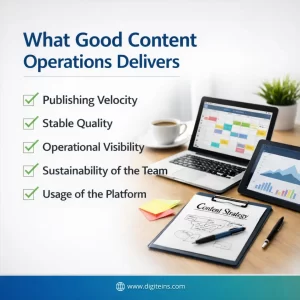
What Good Content Operations Delivers
The results are quantifiable when the content operations are performed well.
Publishing Velocity: Content goes through the request to publication in a predictable and fast manner. Things that used to take a few weeks to be updated are updated within days or hours.
Stable Quality: The number of errors reduces. Brand consistency improves. Published content is believed to be meeting the standards by stakeholders.
Operational Visibility: Stakeholders are able to view request status, comprehend schedules, and get reports on content performance.
Sustainability of the Team: The content team is not always firefighting but working at a sustainable rate. Burnout decreases. Retention improves.
Usage of the platform: CMS is actually. The platform has paid off as was promised by the investment.
The results are through operational commitment and not platform changes. When the same CMS is conducted in a different way, the results are very different.
For specific examples of what operational excellence delivers, see – Why Sitecore Programs Struggle After Year One.
Getting Started With Content Operations
For organizations looking to improve their content operations, several starting points create meaningful impact.
Assess Current State
Know what you have to change before you change it. How do requests arrive? What is the actual workflow? Where do bottlenecks occur? What errors are common? What are the complaints raised by the stakeholders?
This test can prove in most cases that issues are functional and not technical. The platform may be capable. The constraints may be the processes.
Define Clear Ownership
Content operations need someone accountable for their success. Not shared responsibility across multiple teams. Specific ownership with authority to make changes.
This does not require a large team initially. Even one person with clear accountability can begin improving operations.
Establish Basic Governance
Start with fundamentals: Who is allowed to publish, what are the standards, and what permission is needed to publish various types of content. Write down such decisions and implement them.
There is no need for perfect governance. Simple clarity being practiced actually is better than elaborate schemes that are disobeyed.
Build Measurement
Measure simple metrics: the number of requests, response time, and errors. This information displays trends and makes it possible to improve over time.
Value is also exhibited through measurement. As long as stakeholders experience an improvement in metrics, the level of support towards content operations investment increases.
Consider Partners
Determine the most fitting internal build, outsourced partnership, or hybrid model you need. Look beyond cost to access to expertise, scale, and time to effectiveness.
In the case of numerous organizations, joint venturing on content operations offers quicker deliverables and reduced risk as compared to developing internally.
The Future of Content Operations
The content operations are changing with the overall changing digital landscape.
AI is entering content workflows, assisting with drafting, translation, optimization, and quality verification. AI does not replace human judgment but can augment capacity and speed certain tasks.
Composable architectures and headless CMS approaches change how content is structured and delivered, requiring operational models that work across channels rather than just websites.
These trends increase the importance of content operations, not decrease it. More sophisticated platforms require more sophisticated operations to realize their potential.
Got Questions?

Enterprise content operations is the ongoing work of running a content ecosystem at enterprise scale. It includes daily publishing, content governance, multilingual management, quality assurance, platform optimization, and continuous improvement. Unlike implementation (which is project work with an end date), content operations is continuous operational work that happens every day.
Content strategy establishes what, who and why content will be created. The operationalized form of that strategy is content operations, which is executed in workflows, processes, and day-to-day execution. Strategy gives a sense of direction. Operations offers implementation. They both are required in content success.
Struggles that emerge are vague ownership (everyone has a role in platform maintenance), insufficient capacity (teams that are created with an average workload but see peaks), skills (the mix of platform knowledge and editorial ability demanded is hard to find) and investment (organizations fund implementation and underinvest in continuous operation).
Good content operations needs platform knowledge (knowledge of the content quality and standards), editorial skills (knowledge of the quality of the work and its standards), process discipline (ability to follow and improve the working process), project coordination, quality orientation, and communication capabilities. Such a mix is quite uncommon and, that is why, competent content operations specialists can be useful.
Both models can work. In-house offers optimum control and institutional know-how, but is costly, difficult to hire, and limited in capacity. Outsourcing is a source of expertise and scalability though it needs a robust partnership and knowledge transfer. Hybrid methods involving a combination of the models are common in many organizations.
The metrics that are important are the publishing velocity (the time it takes to publish a content), quality rate (the percentage of published content that has no errors), capacity utilization (workload in comparison to capacity), stakeholder satisfaction, and platform utilization (are the capabilities of CMS actually being used). Continuous improvement is made possible through the tracking of these metrics.
