

Why Sitecore Programs Fail After Year One | The Hidden Operational Gap
The celebration was over. The champagne was flat. The implementation partner had gone on to their next project.
Somewhere inside your building, a marketing manager was staring at a powerful Sitecore platform and thinking: Now what?
It is the repetition of this story from one enterprise to another. A CMS multi-million dollar investment is rolled out to cheers and salvation. A year later, the same platform lies underused, the content is not regular, and the team that was to manage it is drowning.
The tendency is so widespread that it has to be named. We refer to it as implementation hangover.
The Disconnect between Platform Capability and Platform Performance.
The market of web content management software is expanding at a faster rate compared to the overall software market. As the study conducted by Forrester shows, the market is growing at a rate of 13.5% percent compound annual growth rate and is expected to have hit 15.3 billion by 2028.
Organizations are investing heavily in platforms like Sitecore, Adobe Experience Manager, and Contentful. The technology is capable. The features are robust. Global brands trust these platforms to deliver sophisticated digital experiences.
Yet Sitecore’s own research tells a different story about what happens after implementation.
In their Websites 2025 report, which surveyed 200 marketing executives across the US, Canada, the UK, and Australia, the findings are striking:
- Only 32% of marketers feel their CMS supports personalization effectively, despite
92% saying personalization is vital to their website’s success. - Only 13% are very confident that their CMS will help them take advantage of AI capabilities.
- Only 16% of marketing leaders feel their websites support their principal revenue-generation objectives.
These statistics come directly from Sitecore’s press release.
The disconnect is clear. Companies are investing in powerful platforms. Most of those investments are underdelivering on their potential.
This is not a technology problem. Sitecore works. The platform is capable. The problem is what happens after implementation ends.

What Really Goes Wrong Post Go-Live?
Once implementation partners finish a Sitecore project, they provide something useful: a configured platform, trained administrators, documentation, and frequently a brief hypercare period.
After that, they move on to the next engagement. It is their business model, and it is a good one. Project work is implementation. It has a start, a middle, and an end.
The Sitecore ecosystem is not project work, though. It is day-to-day, non-stop work. And that’s where the gap shows up.
The following is what normally occurs within the twelve months after go-live:
Months 1–3: The honeymoon period. Everything is new and controllable. The team is still operating on implementation energy. Training is fresh. Processes seem clear.
Months 4–6: The backlog begins. Requests start piling up. Authors trained during implementation start to struggle. The few who really understand the system are pulled into other priorities. Publishing begins to slow.
Months 7–9: Quality starts to slip. Pages go live with errors. Brand consistency suffers. The wrong version gets published. A broken link on a product page goes unnoticed for weeks.
Months 10–12: The breaking point. The team becomes reactive instead of strategic. Everything feels urgent. Governance structures exist on paper, not in practice. Someone questions the ROI of the CMS investment, and no one has a good answer.
This development is not predetermined, but it is extremely common.
Explore common CMS frustrations and practical fixes to improve content management efficiency.
Five Gaps That Cause the Hangover
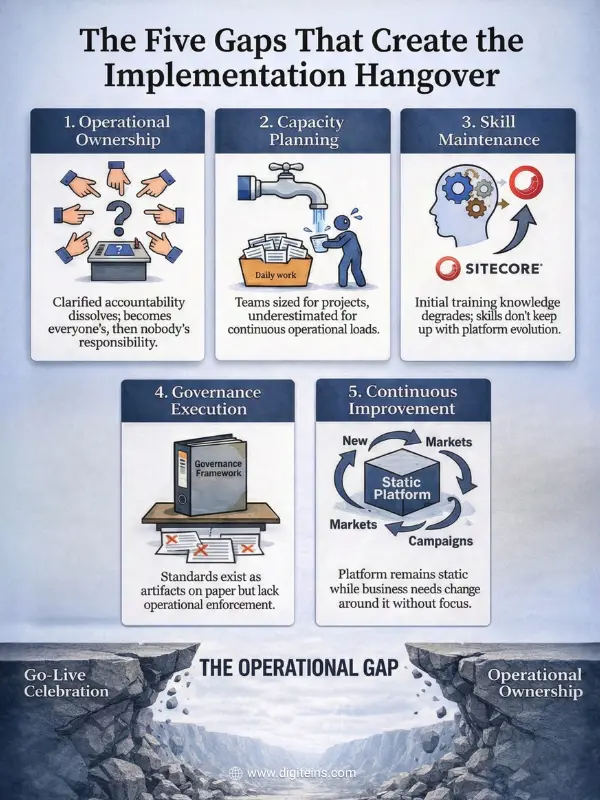
After years of supporting enterprise Sitecore ecosystems, we have identified five distinct gaps that cause post-implementation struggles.
Gap 1: Operational Ownership
Implementation projects have clear ownership. A person will be responsible for the go-live. Someone tracks the timeline, manages the budget, and reports progress.
Once the system has gone live, such clarity tends to soften. Content operations become everyone’s responsibility, which means it is nobody’s responsibility. The website sits between marketing, IT, and digital teams. One of them thinks that the other is doing it.
The result is drift. Small problems accumulate. There is no one who is monitoring the overall health of the content ecosystem.
Gap 2: Capacity Planning
Implementation teams are built for projects. They are short-lived and temporary.
Operational teams need different sizing. They need enough capacity to handle the steady flow of daily work plus the spikes that come with campaigns, product launches, and seasonal pushes.
This is underestimated in most organizations. They assume the internal team can absorb the operational load. They discover that the assumption was wrong when the backlog starts growing, and the team starts burning out.
Gap 3: Skill Maintenance
The implementation needs training, which is not enough. In a session of two or three days, authors are taught the basics. That knowledge starts degrading immediately.
Sitecore evolves. Best practices develop. New features emerge. The people who attended training in month one are using the platform differently in month twelve, and not always in better ways.
Without continuous skill development, teams settle into habits. Some of those habits are inefficient. Some introduce errors. Some underutilize the platform’s capabilities.
Gap 4: Governance Execution
Governance structures are commonly included in implementation projects. They define content standards, approval workflows, and quality requirements.
Those frameworks are excellent on paper. Making them work operationally is a different challenge.
Governance requires enforcement. It requires someone to review content before publication. It requires consistent application of standards even when deadlines are tight. It needs to update the framework when circumstances change.
Without operational commitment, governance documents become artifacts. They sit in SharePoint while the actual work happens, however it happens.
Gap 5: Continuous Improvement
An effective implementation will provide you with a platform that is aligned with your existing requirements. Your needs will change.
New products require new page templates. Acquisitions bring new brands. Market expansions introduce new languages. Campaigns require new components.
The platform is capable of evolving. But evolution requires attention, planning, and execution. Without a dedicated operational focus, the platform becomes static while the business changes around it.
Why Traditional Solutions Fall Short
Organizations recognize these gaps eventually. They try various solutions. Most of those solutions have limitations.
The Marketing Agency Strategy.
Marketing agencies make fantastic campaigns. They know brand and message, as well as creative implementation.
Campaign work is not day-to-day content operations. It is management, predictability, and scale. The majority of agencies are not designed to perform this kind of work. The margins are different. The work is less glamorous. The skills required are operational rather than creative.
There are some agencies that provide content services. Not many of them provide the comprehensive platform knowledge and operational discipline that the business content operations demand.
The Freelancer Network
Freelancers offer flexibility and expertise. They have the ability of filling certain gaps at certain times.
However, enterprise content operations demand consistency, institutional knowledge, and accountability. Freelancers rotate. They are not invested in your long-term success. They cannot provide governance at scale.
Freelancers are good when it comes to specific projects. They are a band-aid and not a solution to continue operations.
The Build-Your-Own-Team Solution.
Some organizations decide to build internal content operations teams. This can work, but it is harder than it appears.
Building a capable content operations team requires multiple hires. You need content authors who understand the platform. You need someone with deep CMS expertise, and Sitecore specialists are not easy to find. You need a governance lead and a coordinator.
The fully-loaded cost often exceeds $400,000 annually for a mid-size operation. Add the time to hire (months), time to productivity (more months), and turnover risk (content roles churn frequently), and the investment is substantial.
For some organizations, this investment makes sense. For many, it is not the best use of resources.
What Operational Excellence Really Means.
The difference between struggling operations and excellent operations is visible in concrete outcomes.
We have seen what structured content operations can achieve with enterprise Sitecore ecosystems. Here are the results from our work with a global enterprise client:
- 469+ content requests processed annually through a structured workflow.
- 450+ translations delivered across six languages, staying synchronized without perpetual backlogs.
- 8 microsites launched in a single year without missing a deadline.
- 17,000+ marketing conversions driven through optimized content operations.
- 18.5% increase in organic search performance year over year.
- 99.5% content accuracy maintained through governance and quality assurance.
These results did not come from a platform change. They came from operational commitment. Same Sitecore platform. Different operations.
The team shifted from reactive to strategic. Instead of fighting fires, they focused on optimization and innovation. Publishing velocity increased. Quality became consistent.
The investment started delivering the returns it promised.
The Question Nobody Asks
When organizations evaluate CMS platforms, they ask detailed questions about features, capabilities, and pricing. They scrutinize the implementation partner’s credentials and approach.
They rarely ask the question that matters most for long-term success:
Who will operate this platform every day after the implementation partner leaves?
This question should be asked before purchasing the platform. It should be answered before the implementation begins. The operational model should be as clear as the implementation plan.
When organizations ask this question early, they make better decisions. They budget appropriately. They plan realistically. They set themselves up for success rather than struggling with the implementation hangover.
Moving Forward
If your Sitecore program is struggling after year one, you are not alone. The pattern is common, and the causes are predictable.
The solution is not working harder with the same approach. It is recognizing that operations require different thinking from implementation.
Start by assessing honestly.
- How is your content quality?
- How quickly do updates publish?
- Is your governance framework working or just documented?
- Is your team sustainable or burning out?
Then consider your options. Building internally may be right for some organizations. Partnering for content operations may be right for others. The right choice depends on your specific circumstances.
The one option that does not work is ignoring the gap and hoping it resolves itself. It will not. Day 366 comes whether you are ready or not.
Got Questions?

The operational gap refers to the period after an implementation partner completes their project and leaves. During this time, organizations often struggle to maintain the daily operations needed to run their Sitecore ecosystem effectively. The gap exists because implementation is project work with an end date, while operations is continuous work that requires different skills, processes, and staffing.
Sitecore programs typically struggle after year one due to five key gaps: unclear operational ownership, inadequate capacity planning, degrading skills without continuous training, governance frameworks that exist on paper but not in practice, and lack of continuous improvement. The technology itself works well. The challenge is operational rather than technical.
A capable internal content operations team for a mid-size enterprise typically costs $400,000 or more annually when you account for salaries, benefits, training, and tools. This includes content authors, a CMS specialist (Sitecore expertise is particularly difficult to find), a governance lead, and coordination. Additional costs include hiring time (2-3 months per role), ramp-up time (6-12 months to full productivity), and turnover risk.
Enterprise content operations is the ongoing work of running a content ecosystem at enterprise scale. It includes daily publishing, content governance, multilingual management, quality assurance, platform optimization, and continuous improvement. Unlike implementation (which is project work with an end date), content operations is continuous operational work that happens every day.
Organizations should plan for post-implementation support before purchasing their CMS platform. The operational model should be as clear as the implementation plan. Waiting until after go-live to address operations typically leads to the struggles described in this article. Early planning allows for appropriate budgeting and realistic expectations.
Most marketing agencies are structured for campaign work rather than daily content operations. The skills, processes, and margins are different. Some agencies offer content services, but few provide the deep platform expertise and operational rigor that enterprise content operations requires. Agencies excel at creative and strategic work. Operations requires different capabilities.
